
Tyche Institute
Open research on AI, digital trust, and governance.
Tyche Institute is a registered Estonian non-profit research association (MTÜ, registry code 80673227) studying how technical systems become accountable inside institutions. Its work connects AI evidence, digital trust infrastructure, public-sector oversight, administrative contestability, procurement, standards, and long-term institutional memory.
Tyche builds and studies signed, timestamped, offline-verifiable evidence — engineered to inform and support human and institutional judgment, not to substitute for it.
Latest verified milestones
Appointments, accepted work, and public engagement
Publication · 4 November 2026
AI export controls, in Frontiers in Political Science
Why a scoped order on two frontier AI systems became a suspension for every user, and what precise enforcement needs at the point of use; vol. 8, art. 1908543, DOI 10.3389/fpos.2026.1908543.
Public engagement · 22 October 2026
Before the Agent Acts, at the Tallinn Kristiine Rotary Club
An invited 30-minute talk for a general audience: 4 questions to ask before an AI agent pays, books or signs for you, and who can check the answers; the questions ran well past their slot.
Publication · 21 October 2026
MIRROR, in the Journal of Open Research Software
Local evidence bundles that keep each claim of an article next to the files that support it, checked by an offline verifier, with the JANUS case study; vol. 14, art. 65, DOI 10.5334/jors.753.
Publication · 20 October 2026
Patent-corpus reproducibility, in World Patent Information
A repair-first pipeline that keeps retrieval failures as versioned negative results, and 13 reporting items for the USPTO Open Data Portal transition; vol. 87, art. 102511, DOI 10.1016/j.wpi.2026.102511.
Teaching · 14 October 2026
Guest lecture at TalTech: Before the Agent Acts
A 60-minute guest lecture with a live poll and quiz in the MSc course Digital Society Principles: Towards e-Governance, on what a verifier must read before an agent's correctly signed action takes effect; the course lead reported positive student feedback.
Research networks · 9 October 2026
COST Action CA25178 starts in Brussels
First Management Committee meeting of the Action on agentic physical AI: officers elected, 5 working groups, and an evidence-and-conformance task carried by Estonia's member.
All news, dated and anchored → · The standing track record →
Field reports
Expeditions
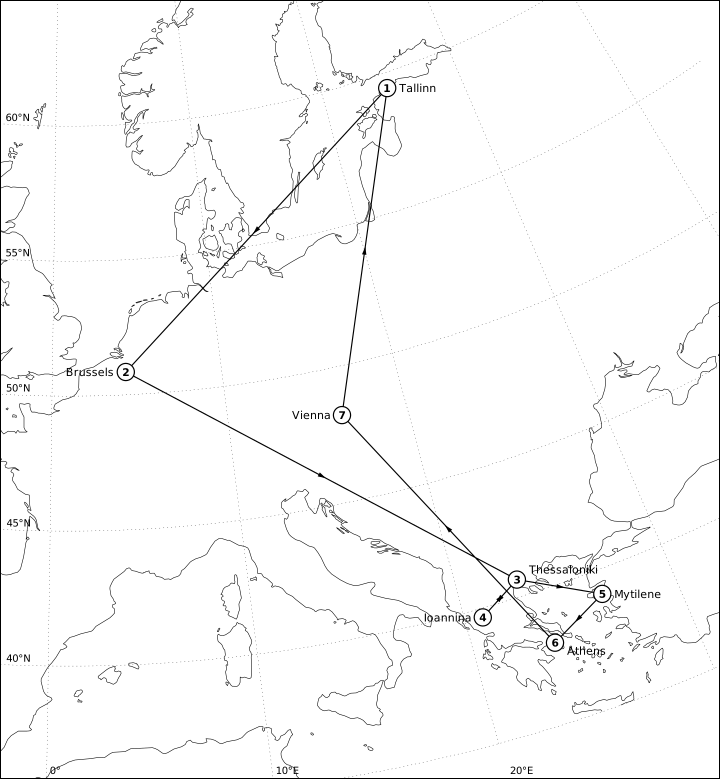
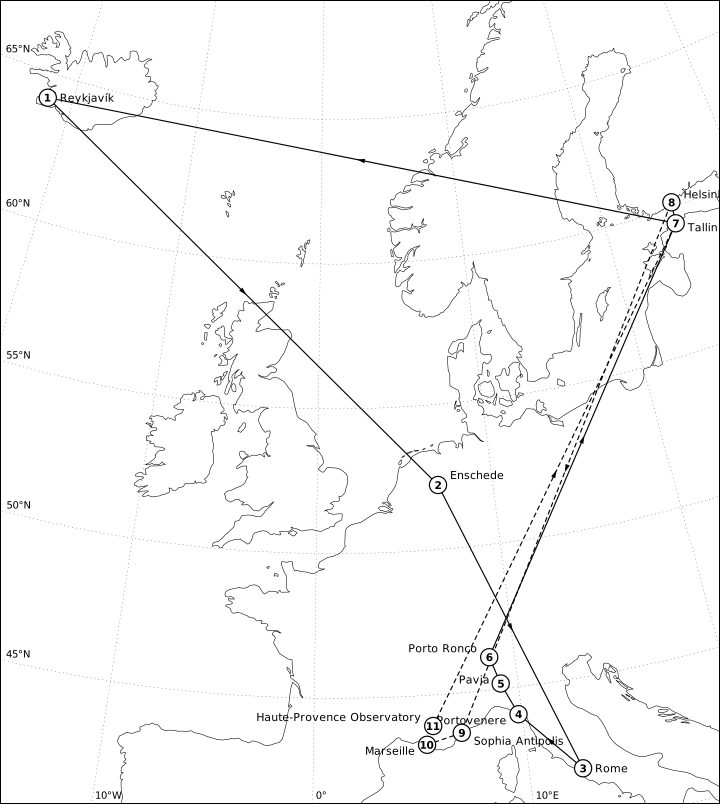
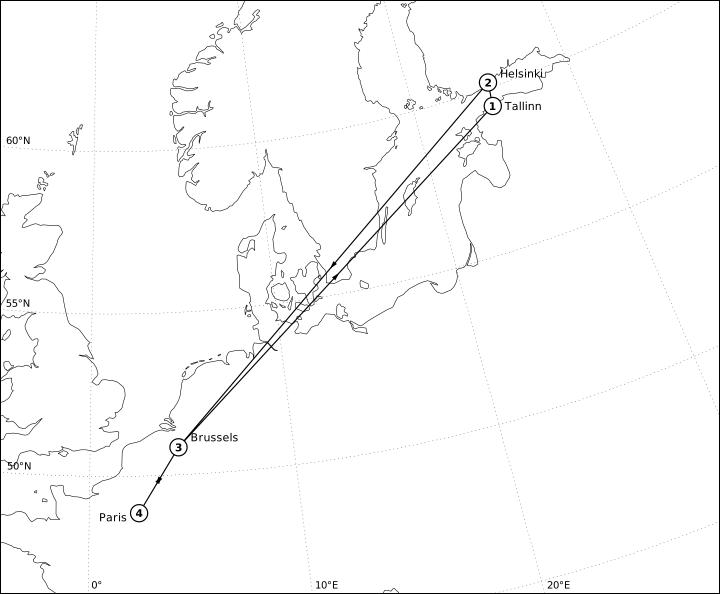
Twice a year the research leaves the desk and goes where the people are who will argue with it. 2 expeditions and an epilogue, with route maps, stops and what came of each.
Public instrument
The EU digital acquis, drawn as one graph
eIDAS 2.0, the AI Act, the GDPR, the implementing acts beneath them, the ETSI and CEN standards they lean on, and the EUDI architecture framework — as segment-addressable nodes with typed cross-corpus edges. Click any segment for its identifier, its exact source, and what it links to.
The discipline is the point. Nothing is drawn without a source row: if a mapping has no file behind it in the research vault, it is not in the graph. Unresolved verification flags are shown rather than quietly settled, and an evidences edge means only that a segment supports evidence for a duty — never that it satisfies one. This is the public tier of the NOMOS regulatory observatory; the row-level evidence layer is held back pending peer review.
Published dataset
Nekropolis is now published in Data in Brief
The final open-access article describes a 14,923-record public corpus of computer-science retractions and AI-governance lifecycle records from 2018-2026.
Research domains
Technology and institutions, studied together
Tyche’s programme is not cryptography with policy added afterward. It follows the full chain from technical evidence to delegated authority, organisational practice, public scrutiny, and repair.
01
Verifiable AI evidence
Provenance, integrity, agent delegation, human-oversight records, and evidence packages that remain inspectable beyond the system that produced them.
02
Evidence infrastructure
Remote attestation, post-quantum transition and public interoperability infrastructure, studied as technical and institutional systems.
03
Governance and public institutions
Public-sector AI accountability, administrative contestability, procurement, standards, regulatory implementation, and the public records needed to scrutinise decisions.
Governance
Evidence is useful only inside an accountable process
For Tyche, governance is the study of how authority, evidence, responsibility, and contestability are organised around technical systems.
Current work examines public-sector AI oversight, digital-state infrastructure, administrative contestability, regulatory and standards implementation, procurement signals, and the public records that let institutions be scrutinised over time.
What we do
Tyche develops public specifications, reference verifiers, and case studies for AI evidence packages: structured artifacts that can be checked after the fact by humans, auditors, researchers, and independent tools.
The programme covers open data and open-government records, public-key infrastructure read as governance, human oversight and agent delegation, educational AI, administrative evidence, and long-term validation under emerging European regulation. The working papers are the canonical statement of scope.
-
Open by design.
Public specifications and reference code where openness is useful; working papers and case studies where research is the right form.
-
Verifiable by structure.
Evidence over belief: provenance, integrity, timestamps, policy context, and human review events that can be checked after the fact.
-
Independent by intent.
Research-first posture: no legal advice, no compliance certification.
Flagship
EATF — Agent Trust Framework
EATF is a research line for verifiable AI evidence packages: signed, timestamped, offline-verifiable artifacts that record provenance, integrity, policy context, model/tool metadata, and human review events.
Current case studies focus on educational AI, civic data, model-card evidence, and research artifact provenance.
Boundaries
Evidence, not overclaiming
Our role is research: we do not certify compliance or give legal advice, and a valid signature does not prove that a claim is true.
From the lab
Bayesian Knowledge Tracing Study Guide
A trilingual, interactive guide to Bayesian Knowledge Tracing, adaptive task selection, explainability, and classroom heatmaps — a safer flagship case for attestable educational AI where teachers remain in control and recommendations can leave replayable evidence.
From the lab
H2O Atlas
A probabilistic risk estimator for Estonian water-quality compliance, built on Terviseamet open data. It originated as a TalTech Masinõpe (spring 2026) coursework project and continues as a Tyche-side testbed for EATF — a transparency tool, not a health advisory.